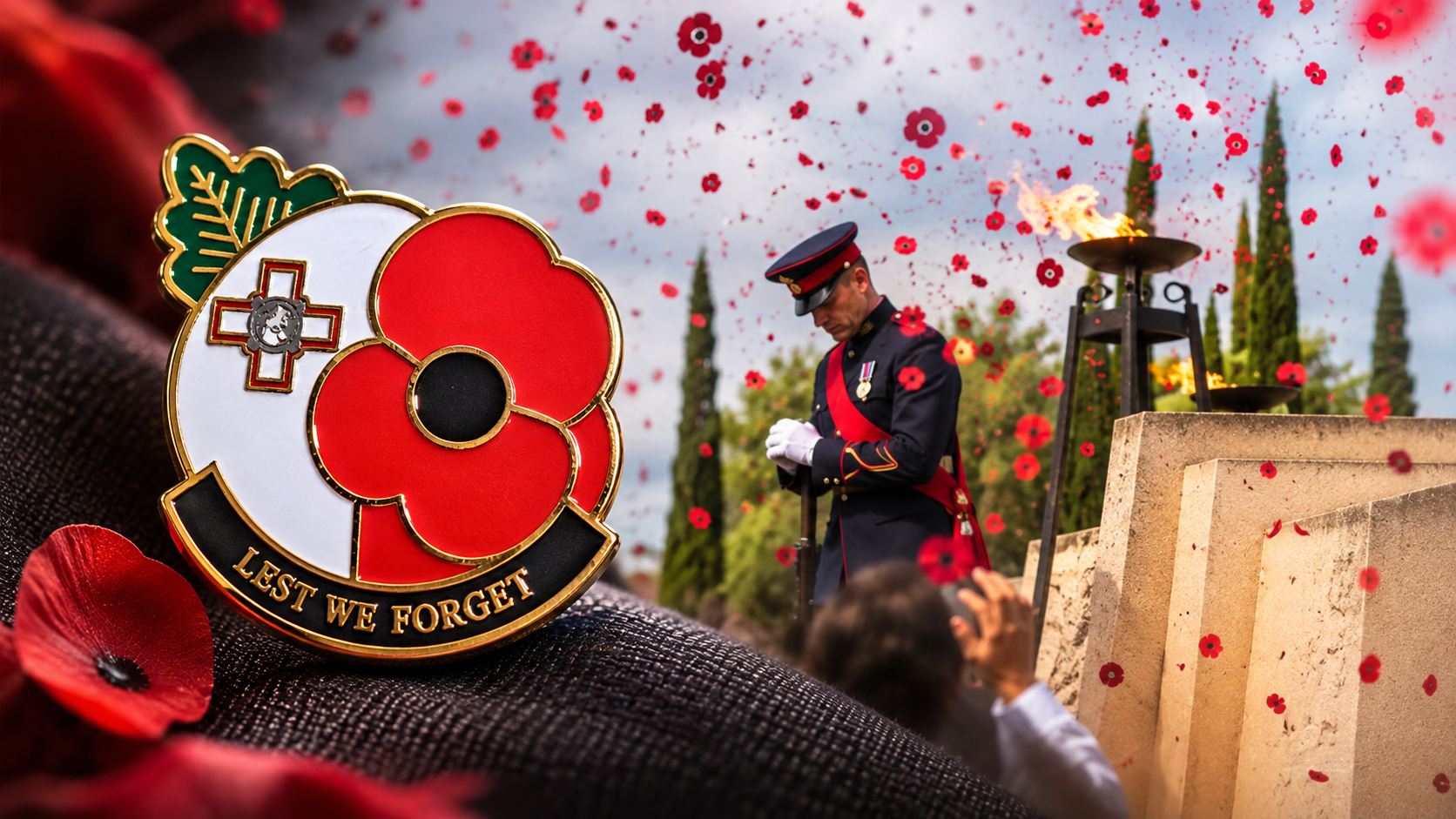
There is something profoundly moving about the sight of thousands of red poppies falling over Malta's War Memorial in Floriana.
As our country marked Remembrance Sunday, that image brought back memories of my schooldays, when the poppy was part of our commemorative activities. We wore it, observed moments of silence and learned about those who had given their lives in war. Perhaps, as children, we did not fully understand the suffering and sacrifice behind that small red flower. Yet its meaning stayed with us.
This year, I was also presented with a commemorative pin in my capacity as Commissioner for Voluntary Organisations. It brings together the red poppy, Malta's George Cross and the words Lest We Forget. A small gesture, but one that made me reflect on how remembrance connects our personal memories, our national history and our responsibilities today.
The poppy's association with remembrance emerged from the battlefields of Flanders during the First World War, where flowers grew amid the devastation. Immortalised in John McCrae's poem In Flanders Fields, it became a symbol of sacrifice and hope.
Yet its meaning reaches beyond Britain and the Commonwealth. In Poland, the red poppies of Monte Cassino recall the Polish soldiers who fought and died there in 1944. The song Czerwone maki na Monte Cassino became an enduring expression of their courage, sacrifice and longing for freedom.
Different histories, but a shared recognition of the human cost of war.
For Malta, remembrance carries particular significance. Our islands endured relentless bombardment, destruction, hunger and loss during the Second World War. The George Cross remains a reminder of the extraordinary courage and resilience shown by the Maltese people.
This is why the ceremonies held each November matter. From the solemn commemoration at St John's Co-Cathedral to the laying of wreaths and military honours at the War Memorial in Floriana, they connect our present with a history that must never become distant or abstract.
But remembrance must also extend beyond ceremony.
The Royal British Legion, through its longstanding presence in Malta and its wider work, embodies an important principle: remembering those who died must go hand in hand with caring for those who served, those who survived and their families.
Its volunteers, its Poppy Appeal and its continuing commitment to welfare demonstrate how remembrance becomes an act of solidarity.
As Commissioner for Voluntary Organisations, this dimension is particularly meaningful to me. Voluntary service is one of the ways a society transforms gratitude into responsibility, and remembrance into practical care for others.
There is another dimension to remembrance that I find increasingly important.
History is often told through events, dates, battles and the decisions of those who led them. Yet history was lived by people. Behind every name engraved on a memorial was a human life, with relationships, aspirations and a future that may never have been realised.
Perhaps this is why the poppy remains such a powerful symbol. It brings the human being back into a story that can otherwise become dominated by institutions, armies and nations.
And perhaps the greatest responsibility of remembrance is precisely this: to ensure that, even as generations pass and the world changes, we never lose sight of the people behind the history.
Looking again at that small pin, and at the image of poppies falling over Floriana, I see a connection between generations. Between the lessons we learned as children, the sacrifices of those who came before us and the responsibilities we now carry.
As fewer people remain who experienced the Second World War firsthand, we have a duty to pass on more than dates, ceremonies and symbols. We must help younger generations understand why remembrance matters, why peace cannot be taken for granted and why human dignity must remain at the heart of our collective memory.
The poppy reminds us of those who gave their lives. The work of organisations such as the Royal British Legion reminds us of those who continue to live with the consequences.
Perhaps the responsibility we inherit is not simply to preserve the memory of history, but to preserve the humanity within it.
Because remembrance is ultimately about people. And so is the future we have a responsibility to build.
Lest We Forget.