I was born into a Europe divided in two.
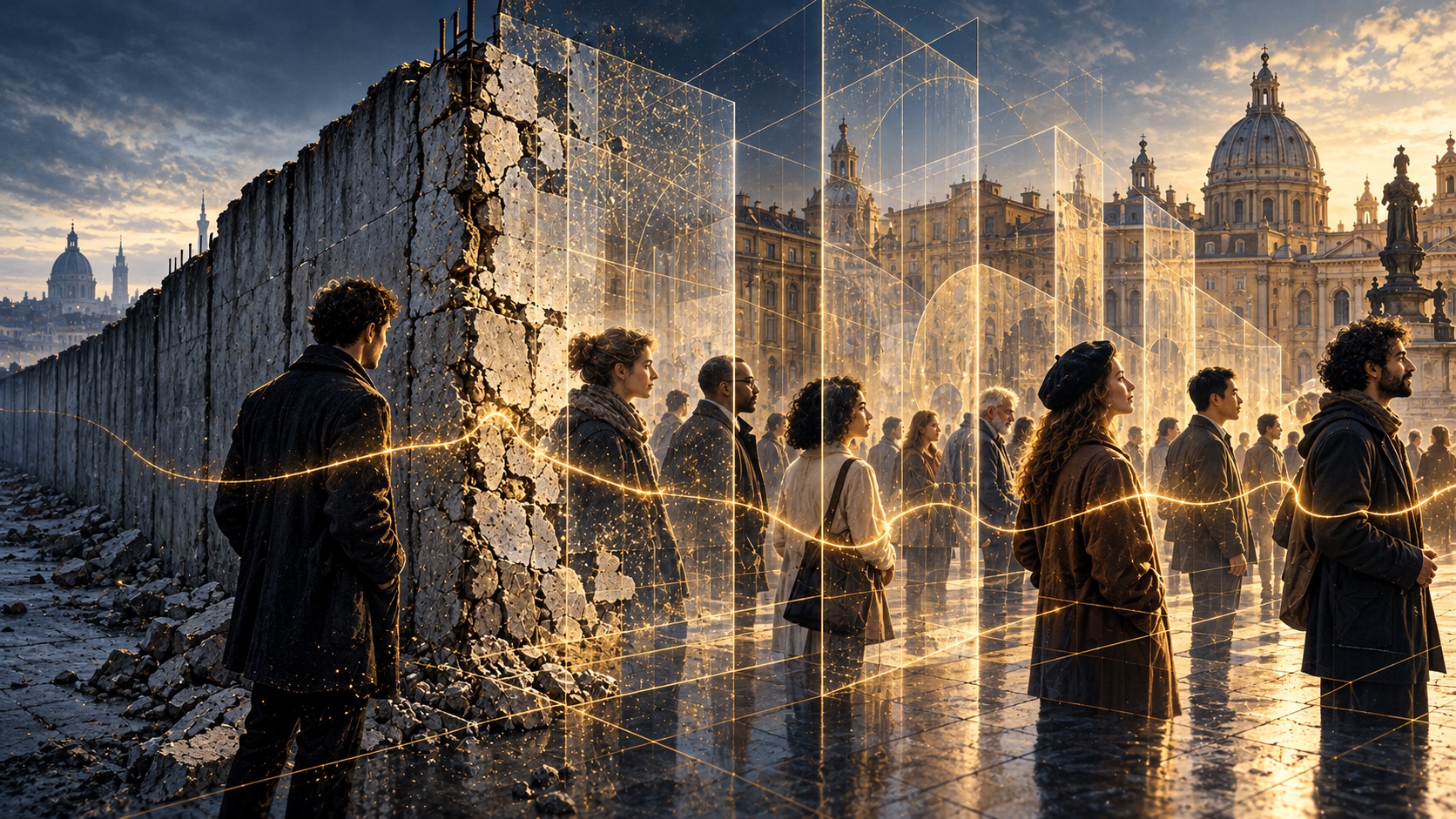
There was the East and there was the West. Two political worlds, two economic systems and two competing visions of society, separated by borders, ideologies and, most visibly, a wall.
For those of us who grew up during the Cold War, the division of Europe was more than a geographical reality. It shaped how we understood freedom, democracy, security and the future.
From Malta, a small island in the Mediterranean, Europe was both a geographical neighbour and a much larger political idea. We were close enough to feel its tensions, yet sufficiently removed to observe some of its contradictions.
The Europe of my childhood was certainly not an ideal place. It carried the consequences of war, authoritarianism, inequality and ideological confrontation. Freedom was not equally enjoyed, and prosperity was far from equally distributed.
But there was something remarkably clear about its divisions.
We knew where the wall stood.
And, in many ways, we understood what bringing it down was supposed to mean.
When the Berlin Wall fell in 1989, it represented far more than the collapse of a physical barrier. It opened the possibility of a Europe that could gradually overcome the political divisions inherited from the Second World War.
The decades that followed brought extraordinary transformation. Countries once separated by ideology became partners. Borders opened. Opportunities for movement, education, employment and cooperation expanded.
Malta’s accession to the European Union in 2004 formed part of that wider historical journey.
For my generation, European integration was never simply an economic arrangement. It carried an aspiration: that nations with different histories, languages and experiences could build something together without surrendering what made them distinct.
And yet, looking at Europe today, I find myself wondering whether we are witnessing the emergence of another kind of division.
Not between East and West.
But increasingly within the societies that we worked so hard to bring together.
The walls we cannot see
The events witnessed in France and Italy during October 2026 brought these questions into sharper focus.
On 17 October, hundreds of thousands of people demonstrated across France over the cost of living and deteriorating public services, following weeks of student mobilisation around conditions in education. Most people exercised their democratic right to protest peacefully. But in several cities, demonstrations were accompanied by serious violence, looting, arson and clashes with the police.
Further demonstrations took place on 24 October. Once again, the principal marches were largely peaceful, but violence occurred after some gatherings ended, including in Paris and Marseille, with disturbances also reported elsewhere.
Italy experienced its own unrest, although the circumstances and combinations of grievances were not identical.
Demonstrations over rising costs, public services and economic pressures were followed by violence in Milan and several northern cities on 17 and 18 October. A week later, further protests took place in cities including Rome, Milan, Turin and Bologna, bringing together concerns about living costs, public policy, war and military spending. Clashes occurred in Turin, Rome and Bologna, while the principal demonstrations in Milan remained largely peaceful.
These events should not be treated as a single European movement. Nor should peaceful demonstrators be made responsible for violence committed by smaller groups operating around or after the marches.
Violence, destruction and attacks on people or property cannot be justified. The right to protest peacefully is fundamental to democracy, but it carries responsibilities that cannot simply be set aside.
Yet I am equally uncomfortable with the speed at which complex events are reduced to convenient explanations.
Foreigners. Immigrants. Young people. Gen Z. The far left. The far right. Failed integration. Failed governments.
Each label offers an apparently straightforward answer.
And each can prevent us from asking more difficult questions.
Who are the people involved? What are their circumstances? Which grievances are legitimate? Who is responsible for the violence? Why are entire generations or communities sometimes made to answer for the actions of individuals?
The protests in different countries did not all begin for the same reasons. The people who participated did not all share the same objectives. Peaceful demonstrations must not be confused with the actions of those who used them as an opportunity for violence.
But the reactions to these events reveal something about how we have begun to see one another.
Increasingly, our differences become the starting point of the conversation rather than something we seek to understand.
The new walls of Europe may be constructed less through geography than through distrust.
When progress is not experienced as progress
Europe has become economically and technologically more capable. We have built institutions, expanded markets, invested in education and developed possibilities that previous generations could scarcely have imagined.
Yet economic progress is not always experienced as personal progress.
A young person may be better educated than their parents but unable to afford an independent home.
A family may live in a growing economy while struggling with everyday expenses.
A worker may contribute more, adapt to new technologies and accept greater responsibilities without feeling more secure.
An older person may look at the society they helped to build and wonder whether the stability they once expected is gradually disappearing.
These are different experiences. But they raise a common question:
What happens when the promise of progress becomes disconnected from the experience of living?
We frequently discuss competitiveness, productivity, innovation and economic growth as though their benefits will inevitably find their way into people’s lives.
But that connection cannot simply be assumed.
It must be deliberately created, sustained and tested against people’s actual circumstances.
Economic pressure does not automatically produce violence. Most people facing hardship do not respond through destruction or confrontation.
But prolonged insecurity can affect how people understand fairness, opportunity and the credibility of institutions.
When people begin to question whether the system still offers them a meaningful future, the consequences extend beyond economics.
They reach into identity, trust and belonging.
Belonging is not passive
The Europe I was born into was divided by competing political systems.
The Europe I am witnessing today faces divisions that are often harder to define.
They exist between generations with different expectations of work and independence.
Between communities experiencing demographic and cultural change at different speeds.
Between those benefiting from economic transformation and those who feel increasingly exposed to its consequences.
And between citizens who continue to trust institutions and those who question whether those institutions still understand their lives.
Migration forms part of this reality, and Europe should be mature enough to discuss it without reducing every concern to prejudice or every difficulty to the presence of foreigners.
Migration has economic, demographic, cultural and human dimensions. It can contribute to economic activity and help address labour shortages. It can also create additional demands that require planning, investment and effective integration.
These questions deserve evidence rather than slogans.
We should also remember that a young European whose parents or grandparents came from elsewhere is not automatically a foreigner.
Responsibility for criminal behaviour belongs to those who commit it—not to an entire nationality, religion, community or generation.
Integration is not merely about allowing people to live alongside one another. It concerns the conditions through which people can participate, contribute, accept shared responsibilities and experience genuine belonging.
But the same principle applies to those who have lived in a community for generations.
Their concerns, expectations, identity and sense of security also deserve recognition.
A shared society cannot be built by asking one group to surrender its dignity so that another may feel accepted.
Nor can belonging survive without responsibility.
Europe beyond its structures
I sometimes wonder whether, in our enthusiasm for building a more integrated Europe, we concentrated so much on the structures of integration that we underestimated the continuing work required to sustain its human foundations.
We created institutions, agreements, markets and freedoms.
These were remarkable achievements.
But institutions cannot manufacture trust simply by existing.
A common market does not automatically create a common sense of purpose.
Freedom of movement does not, by itself, guarantee social integration.
Economic growth does not necessarily produce a feeling of shared prosperity.
These outcomes require relationships between people, communities and institutions. They require fairness, accountability, participation and the conviction that individual contributions matter.
Perhaps one of the most important questions facing Europe is whether we have become better at managing economic systems than at understanding the people living within them.
A society may appear economically successful while becoming socially fragmented.
It may have functioning institutions while confidence in their legitimacy weakens.
It may celebrate diversity while struggling to create the shared responsibilities through which diversity becomes a source of collective strength.
A different European question
I do not believe the answer lies in romanticising the past.
The Europe of my childhood was not more humane simply because its divisions were more visible.
Nor should we dismiss the considerable freedoms, opportunities and improvements achieved over the decades.
But history offers us a useful perspective.
The generation that witnessed the fall of the Berlin Wall understood that Europe’s future depended on overcoming divisions that had come to appear permanent.
Today, the challenge is different.
We are not being asked to reunite two opposing political blocs.
We are being asked how societies undergoing profound economic, technological and demographic change can maintain a credible sense of shared citizenship.
How do we ensure that younger generations can build independent lives without making older generations feel that their contributions have been forgotten?
How do we reconcile the economic need for migration with the social responsibility to plan, integrate and sustain communities?
How do we pursue competitiveness without losing sight of the people whose work, skills and aspirations make competitiveness possible?
How do we protect freedom, public order and democratic disagreement without allowing fear to define our relationship with one another?
These questions cannot be answered by blaming a generation, a community or a political ideology.
They demand something more difficult.
They require us to recognise that people can experience the same society very differently—and that understanding those differences is essential to building a future they can share.
The next wall
I was born into a Europe whose most recognisable division was a wall.
I have lived through a period in which that wall disappeared and a different European possibility emerged.
Today, I see extraordinary achievements alongside tensions that deserve neither exaggeration nor dismissal.
I see generations who have inherited opportunities their grandparents could only imagine, but who also face insecurities those grandparents might struggle to understand.
I see communities changing, institutions being questioned and societies trying to reconcile economic necessity with human expectations.
And I see how easily public debate can turn shared challenges into competing identities.
Perhaps the lesson of the Europe I was born into is not simply that walls can fall.
It is that bringing down a wall does not, by itself, create understanding between the people who once lived on opposite sides of it.
That work must continue long after the celebrations have ended.
The same is true today.
We cannot build a shared European future by removing the barriers between countries while allowing new barriers to grow between the people living within them.
For me, that is the tale of two Europes.
One in which we could see the divisions on a map.
And another in which we must learn to recognise the divisions in people’s lives.
The first taught us the importance of freedom and unity.
The second is challenging us to understand what makes freedom and unity meaningful in everyday life.
Perhaps the question for my generation is not whether we succeeded in bringing Europe together.
It is whether we have done enough to ensure that the generations who follow us can continue to feel that they belong to it.
Because the greatest achievement of Europe should not simply be that we learned to live without walls between us.
It should be that we continue learning how to live with one another.