On Monday, Malta presented its Budget for 2027. Two days later, the United Kingdom presented its own.
Two countries with very different economies, pressures and priorities. Yet, reading beyond the individual measures, I was struck by what they share. Both are trying to answer today’s needs while preparing for a future that will ask very different things of their people and their institutions.
Budgets naturally draw attention to taxation, benefits, wages, pensions and investment. These matter. For a family stretched by rising costs, a pension increase or a cost-of-living adjustment is not an abstract policy decision. It is the difference between managing and struggling.
But there is a second question that rarely makes the headlines.
Are we simply allocating resources to meet today’s needs, or are we also creating the conditions through which people, organisations and institutions become more capable tomorrow?
Two economies, different starting points
Malta approaches its budget from a position many European economies would envy. Our economy continues to generate growth and employment. The measures announced include support for families and pensioners, adjustments to personal taxation and incentives for business investment. For people feeling the weight of rising costs, these interventions have real value.
Yet Malta continues to confront a question that has moved to the centre of our national conversation. How do we move from a growth model that has relied heavily on adding more people to the workforce, towards one that creates greater value through productivity, capability and innovation?
That question cannot be answered through taxation or incentives alone.
The British Budget arrives against a different background: pressure on household finances, public services, energy costs and a long-standing productivity problem. Alongside immediate support, it gives notable attention to artificial intelligence, to the reform of public administration and to the relationship between central government and the regions.
What interests me is the recognition, implicit in both, that an economy’s performance depends not only on how much is invested. It depends on how well its institutions, infrastructure, businesses and people work together.
Adding people is not the same as creating capability
The Maltese Budget raises the cost of employing third-country nationals, through higher permit fees and the withdrawal of some benefits for recent arrivals, while offering incentives to encourage business investment.
Whatever one’s view of these measures, their implications deserve careful thought. A higher cost of recruitment may change hiring decisions. It does not, by itself, make an organisation more productive. No organisation transforms simply because labour becomes more expensive.
We should also remember that behind every work permit is a person, with skills, experience and aspirations of their own. A labour-market policy that sees people only as a cost line risks overlooking the very capability we say we are short of.
Real transformation asks more of an organisation. It must understand its own processes, recognise the capabilities of its people, identify where knowledge is being underused and determine where technology can genuinely improve the way work is done.
This brings me to something I return to often in my work.
We speak constantly about skills shortages, recruitment difficulties and the need to attract talent. But how well do we understand the capabilities already present inside our organisations? How many people hold knowledge and abilities that their current roles never allow them to show? And how often do employers look outside before looking within?
The future of work is not only about the skills we need to acquire. It is about recognising, connecting and developing the capabilities we already have, and building the bridges that allow people to move from one role to the next.
Every organisation has an identity. Few have fully mapped their potential.
Technology does not transform organisations on its own
One of the more striking features of the British Budget is the scale of its commitment to artificial intelligence: hundreds of millions of pounds for AI safety, sovereign capability, procurement and research into AI’s economic impact, alongside a wider push to modernise public services.
There is growing recognition that technology can raise productivity, reduce administrative burdens and strengthen public services. But technology alone does not guarantee better outcomes.
Introducing AI without examining processes, workforce capabilities, governance and accountability risks adding new layers of complexity rather than resolving old ones. A public institution may install a more sophisticated digital system while keeping the same fragmented responsibilities and disconnected information. An employer may invest in automation without asking how the roles and capabilities of its people should evolve.
The technology is new. The underlying organisational challenge is unchanged.
This is why I prefer to speak of co-intelligence rather than artificial intelligence alone. The real opportunity emerges when technology is joined to human knowledge, responsible judgement and purposeful organisational change, with people remaining accountable for the decisions that matter.
The question is not simply what artificial intelligence can do, but what people and organisations can achieve when human and machine intelligence work together.
That distinction matters for both countries. It matters even more for a small state like Malta, which cannot outspend larger economies on technology but can choose to integrate it more intelligently.
What happens between institutions?
The British Budget also turns attention to fiscal devolution: where decisions are made, how resources are distributed, and how accountability can sit closer to the people affected.
The British institutional landscape is very different from ours. The underlying question is not. How effectively do our institutions work together?
Education, employment, enterprise, infrastructure, health and social policy are administered through separate structures, each with its own mandate, programmes, budget and performance measures. Yet people do not live their lives along those administrative lines.
A person’s ability to work may depend on education, transport, housing, health and family circumstances all at once. A business’s capacity to invest may depend on workforce availability, infrastructure, regulation, finance and the reliability of public services. A community’s wellbeing often rests on relationships between institutions that never appear together under a single budget heading.
My years working with Malta’s voluntary sector taught me that some of the most effective work happens precisely in those gaps, where civil society, local communities and public services meet. Seen from Gozo, the point is even sharper: distance from the centre turns every gap between institutions into a lived experience.
Governments allocate resources through separate departments. People experience the consequences together.
Aligning what happens inside institutions with what people experience outside them is where many of the opportunities for genuine progress lie.
From responding to problems to anticipating them
The British discussion of preventative spending raises an important question about how we value public investment.
We usually measure expenditure by the services provided, the programmes delivered or the problems addressed. But what of the problems that good intervention prevents? What is the value of helping someone remain healthy, employable, connected and independent? Of supporting a family before difficulties become a crisis? Of recognising a skills gap before it becomes a workforce shortage?
Prevention requires a different understanding of investment, and a different kind of institutional capacity: the ability to read signals early, to look ahead, and to act before the cost of inaction arrives. That is what foresight offers government, and it is a capability small states can build faster than large ones.
It is especially relevant to wellbeing.
Wellbeing is not an additional social expense or a separate policy area. It is part of the infrastructure of a productive economy, connected to participation, public health, community life and the sustainability of our economic and social systems.
For Malta, where economic growth, population pressure and the demands on infrastructure are tightly linked, this deserves particular attention. An increase in income matters. So do the hours people spend in traffic, their access to housing and services, the quality of their environment and their opportunity to take part in community life.
Economic progress should ultimately be measured in the lives people are able to lead.
Resources, capability, outcomes
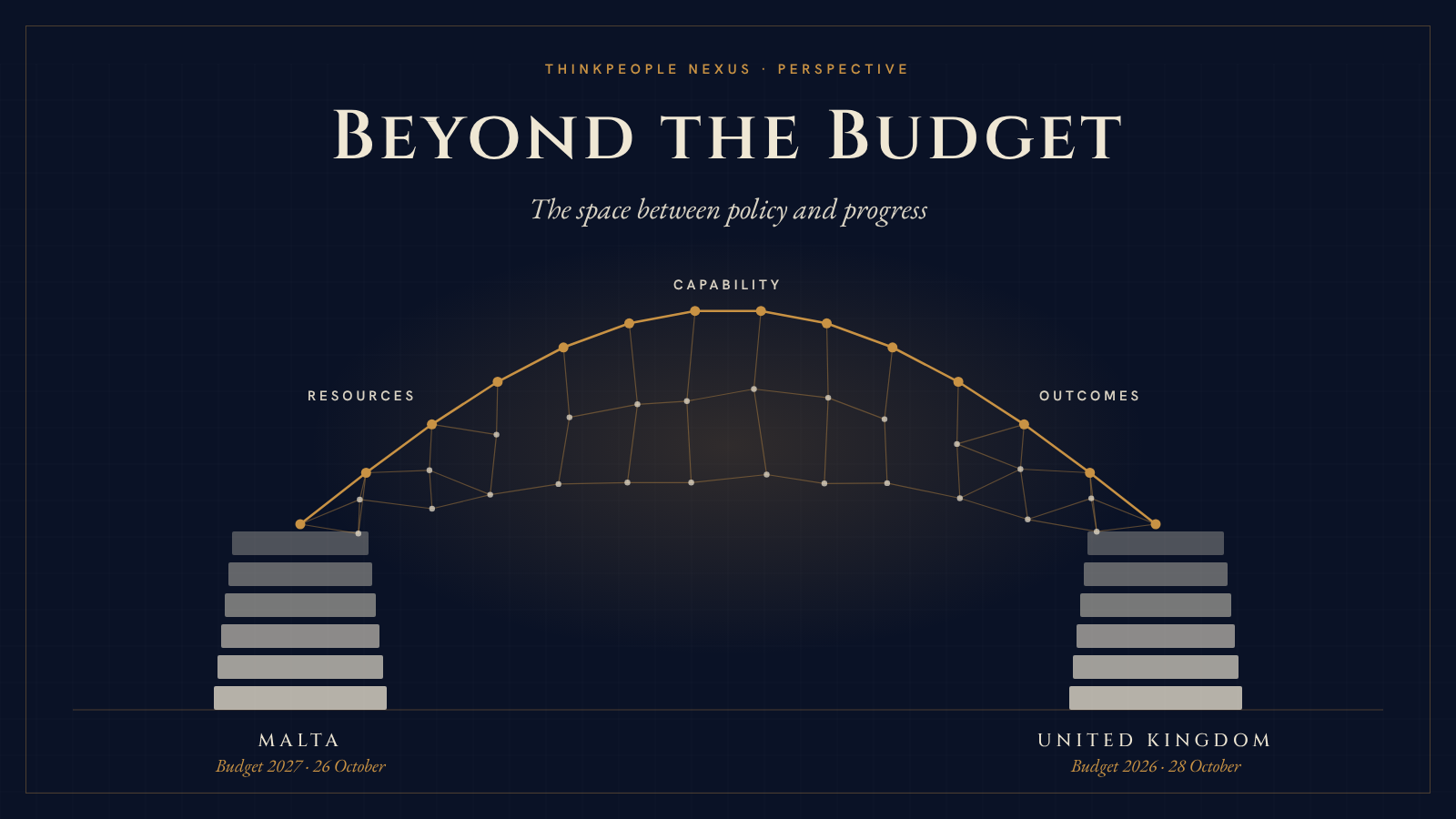
Reading the two budgets side by side, I see three distinct but connected layers.
The first is resources: the money, infrastructure, incentives and public investment governments make available.
The second is capability: the knowledge, skills, institutional effectiveness, technology and organisational conditions needed to use those resources well.
The third is outcomes: the improvements in productivity, opportunity, public services and wellbeing that people and communities actually experience.
These layers are related, but they are not interchangeable. Allocating resources does not automatically create capability. Building capability does not automatically deliver outcomes. And an immediate result does not mean the conditions to sustain it are in place.
The links between them are where the work lies. They require evidence, coordination, responsible judgement and continued stewardship.
The UK is trying to reconcile immediate economic pressure with reforms to investment, public services and the machinery of government. Malta is supporting households and economic activity while facing hard questions about the direction and sustainability of its growth model. The circumstances and choices differ. But neither country’s long-term challenges can be solved by individual measures working in isolation.
The space between policy and progress
Governments, businesses and institutions today have access to extraordinary amounts of information, expertise and technology. We keep producing new programmes, strategies, systems and solutions.
Yet many of our challenges persist, not because the individual pieces are missing, but because the relationships between them are fragmented, poorly understood or badly coordinated.
A budget provides the resources. A strategy sets the direction. Technology opens new possibilities. But it is people, organisations and institutions working together that turn those possibilities into outcomes.
This is why the real significance of a budget extends far beyond the day it is presented. Its success cannot be judged only by what was allocated, announced or promised. It must be judged by what becomes possible as a result.
- Can people develop and contribute more fully?
- Can organisations become more capable?
- Can institutions make better decisions and work together more effectively?
- Can economic growth translate into better lives?
These questions remain long after the budget debate has moved on.
The world has no shortage of solutions. It has a shortage of integration.
That is where some of our greatest opportunities lie. Not simply in adding more resources, more programmes, more technology or more people, but in understanding how the capabilities already within reach can be connected and developed with purpose.
A budget tells us how a country intends to use its resources. What happens between budgets tells us whether that country is learning to realise its potential.
It is in that space, between policy and progress, that much of our future will be shaped.
Jesmond Saliba
Founder, ThinkPeople Nexus