We are living through an extraordinary expansion of intelligence.
Systems can interpret information, identify patterns, generate ideas, translate languages and support decisions at a speed that would have been difficult to imagine even a few years ago.
The question is no longer whether artificial intelligence will become part of our lives.
It already has.
The more important question is what kind of life we are creating around it.
Will greater intelligence help us understand one another more deeply?
Will faster communication strengthen our relationships?
Will better systems give people more space to exercise judgement, imagination and care?
Or might we become more connected while gradually losing something in the relationship itself?
I do not believe the future depends on choosing between people and technology.
But I do believe it depends on understanding what each can contribute—and what neither should be expected to replace in the other.
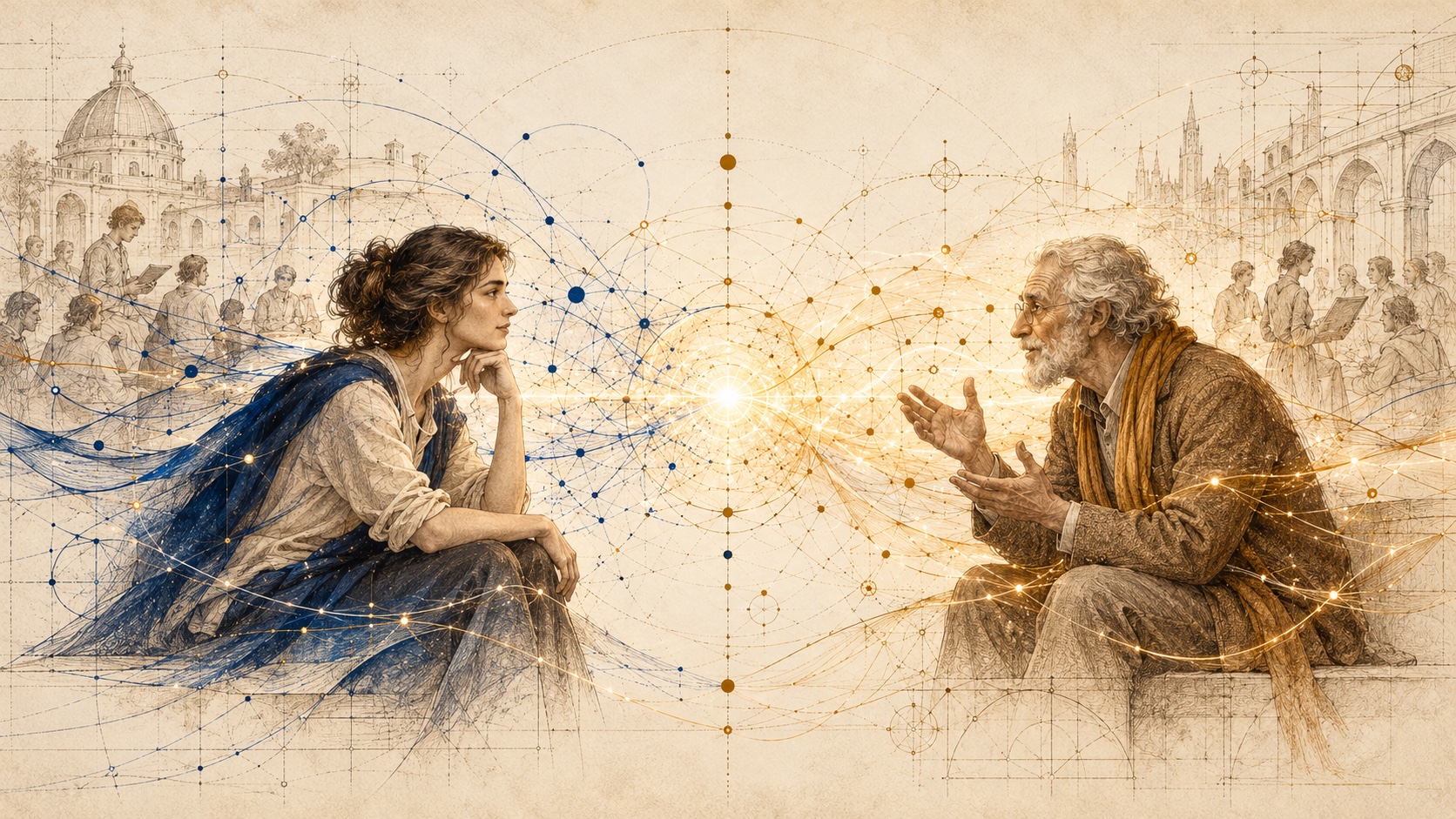
Because there is something between people that cannot be reduced to information passing from one point to another.
It is where trust forms.
Where meaning is negotiated.
Where disagreement can be held without becoming separation.
Where someone feels listened to rather than merely processed.
And where knowledge gradually becomes judgement.
That space between us may be one of the most important things we carry into the future.
Connected, but not necessarily in relationship
We have more ways to communicate than any generation before us.
Messages cross the world instantly. Meetings take place across continents. Information that once required days of research can be assembled within seconds.
Artificial intelligence can help us prepare, summarise, compare, write and decide.
These are considerable advances.
But connection and relationship are not the same thing.
A connection can transmit information.
A relationship carries context.
It remembers what was said, but also recognises what could not yet be said.
It allows people to question, hesitate, reconsider and disagree without every uncertainty being treated as a failure.
It creates the conditions through which people can be honest about what they do not know.
This is particularly important in organisations.
The pressure to become faster and more efficient can make every pause appear wasteful. A difficult conversation becomes a delay. A dissenting view becomes resistance. The person asking for more time becomes the obstacle between the organisation and its preferred answer.
Technology can reinforce that tendency because it often gives us something that appears complete.
A recommendation.
A summary.
A probability.
A confident response.
But confidence is not the same as wisdom.
And the best available answer is not automatically the right decision.
Someone must still ask what the answer means for the people affected by it.
Someone must recognise what the data does not show.
Someone must decide whether the most efficient course is also the course the organisation is prepared to defend.
Those responsibilities remain human.
The renaissance we now require
The Renaissance is often remembered through the extraordinary works it produced.
Art. Architecture. Engineering. Anatomy. Scientific observation. New ways of representing the human being and the world.
But its deeper importance may lie in the relationships it renewed.
Between art and science.
Observation and imagination.
Knowledge and human possibility.
The Renaissance did not advance by insisting that every discipline remain inside its own boundary. It created spaces in which different forms of understanding could meet.
That is one reason Leonardo continues to speak to us.
He represents more than individual genius. He represents curiosity moving between fields that later generations would separate.
Our own age requires a different renaissance.
We do not need to reproduce the past or romanticise it. We need to recover its willingness to connect what has become fragmented.
Technology with purpose.
Intelligence with judgement.
Capability with responsibility.
Innovation with its human consequences.
This is the opportunity within the idea of a digital renaissance.
Artificial intelligence is not merely another instrument added to the collection. It changes how knowledge is produced, how decisions are prepared and how people participate in work and society.
That makes it too important to be treated only as a technical development.
The real measure of this renaissance will not be the volume of content generated, the number of tasks automated or the speed at which decisions can be reached.
It will be whether these capabilities help people and institutions become more thoughtful, more responsible and more able to act together.
Keeping the human at the centre
“The human must remain at the centre” has become a familiar statement.
It is easy to say.
It is more difficult to practise.
Keeping people at the centre does not mean placing a human signature beneath a decision largely shaped elsewhere. It does not mean asking someone to approve an output they did not have the time, evidence or authority to question.
Nor does it mean assuming that a system is human-centred because it has been made convenient to use.
A genuinely human-centred approach asks more demanding questions.
Whose experience informed the system?
Whose circumstances were treated as normal?
Who may be excluded because their life does not fit the expected pattern?
Who has the authority to challenge the recommendation?
Who remains responsible when the outcome causes harm?
And is the person encountering the system treated as a participant—or merely as a subject of its process?
At ThinkPeople Nexus, we use the idea of HUMaiNE to describe the human experience that should result when intelligence and technology are governed with dignity, belonging and stewardship.
The test is not whether the technology can describe itself as humane.
Technology does not inherit human responsibility simply because it can participate in human decisions.
The test is whether the person affected experiences the relationship as humane.
Are they seen?
Are they heard?
Can they understand what is happening?
Can they question it?
Is their dignity preserved when the easiest or fastest answer would disregard it?
Governance can establish rules and boundaries.
Stewardship asks whether human dignity is being held within them.
From co-intelligence to Co-Wisdom
Artificial intelligence can contribute capability.
It can help people recognise patterns, draw connections, test possibilities and work with quantities of information that would otherwise be difficult to hold together.
Human beings contribute experience, values, context and accountability.
Bringing these contributions together creates the possibility of co-intelligence.
But co-intelligence is not the destination.
It tells us how different forms of intelligence may work together. It does not, by itself, determine what that collaboration should serve.
That requires wisdom.
Wisdom is not another output.
It is exercised through judgement.
It may require accepting the most efficient answer. It may also require rejecting it because the human consequences are too serious, the evidence too uncertain or the people affected have not been adequately heard.
This is where co-intelligence must mature into Co-Wisdom.
The purpose is not to transfer human authority to technology.
It is to strengthen our ability to use knowledge responsibly, while preserving human accountability for consequential choices.
The distinction matters.
An organisation may possess more intelligence than at any point in its history and still make an unwise decision.
A government may have extensive evidence while failing to understand how a decision will be experienced by the people expected to live with it.
A leader may receive an excellent analysis but lack the relationships through which concerns can be raised honestly.
The missing element is not always more information.
Sometimes it is the quality of the space in which information is interpreted.
Relationship as infrastructure
Human relationship is sometimes treated as something soft.
Important, perhaps, but secondary to strategy, technology and performance.
I believe the opposite is true.
Relationship is part of the infrastructure through which strategy becomes possible.
People share what they know when they trust how that knowledge will be received.
They challenge a decision when disagreement does not threaten their belonging.
They admit uncertainty when not knowing is treated as the beginning of responsible inquiry rather than evidence of weakness.
They collaborate across functions when they understand that their distinct contribution will not be absorbed or disregarded.
Without these conditions, organisations fragment.
Information remains inside departments.
Experience goes unrecognised.
Technology is introduced without sufficient understanding of the people expected to use it.
Decisions appear aligned because those who disagree have stopped speaking.
The organisation may still function.
But its capacity for judgement becomes weaker.
Relationships do not remove disagreement. They make responsible disagreement possible.
They do not eliminate uncertainty. They create the trust through which uncertainty can be examined.
They do not guarantee wisdom. But wisdom has little chance of emerging without them.
This is the NEXUS.
Not simply a collection of people, systems and technologies brought into the same room.
It is the purposeful relationship between evidence, lived experience, capability and responsibility.
The value is not only in the individual elements.
It is in what becomes possible between them.
What are we becoming more efficient for?
The purpose of technology is not to preserve every existing task or require a person to perform work that can be done more effectively in another way.
There are activities that should become easier.
Processes that should become faster.
Administrative burdens that should be reduced.
People should be able to benefit from these advances.
But every gain in efficiency should allow us to ask a further question:
What are we becoming more efficient for?
If technology releases people from repetitive work, what will they gain the time and opportunity to do?
Will they be able to think more deeply?
Learn new capabilities?
Attend more carefully to another person?
Exercise greater judgement?
Create something that previously remained beyond their reach?
Or will the saved time simply be absorbed into a greater volume of activity, leaving people moving faster while experiencing less purpose and less connection?
Efficiency has no human direction of its own.
We give it direction through the choices we make around it.
The same technology can create time for relationship or become a reason to remove it.
It can help a professional understand a person more fully or encourage them to move more quickly to the next case.
It can make knowledge more accessible or strengthen the advantage of those already best positioned to use it.
It can widen participation or quietly route around those whose needs are more complex.
That is why the human question cannot be added at the end.
It must shape the purpose from the beginning.
The responsibility of this moment
I do not fear intelligence.
I fear the possibility that we may confuse intelligence with understanding, connection with relationship and acceleration with progress.
The answer is not to resist technology or retreat from the possibilities it offers.
It is to become more deliberate about the future we are creating through it.
That future will require governance.
It will require technical capability.
It will require education, evidence and new forms of participation.
But it will also require something older and more demanding.
The willingness to remain in relationship with one another.
To listen before concluding.
To recognise the person who does not fit the model.
To accept that a slower decision may sometimes be the more responsible one.
To preserve space for doubt, challenge, imagination and care.
And to remember that no system, however capable, carries the moral responsibility that belongs to the people and institutions choosing how it will be used.
The next renaissance will not be secured simply by producing more intelligence.
It will depend on whether intelligence helps us become more capable of wisdom.
More able to recognise one another.
More willing to accept responsibility for the consequences of our choices.
And more conscious of the relationships through which progress becomes meaningful.
The future is not AI.
The future is what becomes possible when it is us.
Because the space between us is not empty.
It is where trust is formed.
Where judgement becomes possible.
And where the future, ultimately, is created.